Friday, October 23, 2026

NILDS AfCFTA Policy Programme records key milestones


The Division of AfCFTA Law and Policy Programme (DALP), Office of the Director-General, National Institute for Legislative and Democratic Studies (NILDS), says it has recorded significant milestones in its first year of operation from October 2025 to October 2026.

In a one-year scorecard titled “Small Steps Towards A Bigger Impact”, the director in charge of the Division, Prof Muhammed Tawfiq Ladan, said the activities of the Division have enhanced NILDS’ international visibility, formed new strategic partnerships and built the capacity of about 400 diverse stakeholders on AfCFTA.

Prof Ladan said the Division commenced with a hybrid sensitisation programme for NILDS staff in November 2025, where about 70 staff were sensitised on AfCFTA, followed by a continental training programme co-organised by UNECA and NILDS in Abuja in March 2026 to enhance and certify the capacity of over 150 legislators, clerks, legislative aides, National Assembly legal officers and NILDS research officers.

According to the report, the Division also facilitated the LA-NILDS Certificate/Conference from April 2026, where 48 participants were certificated and about 200 participants and dignitaries attended the International Law Association (ILA) Conference.

The report noted that 12 NILDS staff became registered members of the ILA, while the Director-General of NILDS was conferred with the ILA Lifetime Achievement Award.

On publications and advocacy, the Division stated that AfCFTA Policy Briefs 1-15 have been uploaded on the NILDS website library space, while a Compendium on AfCFTA instruments has been compiled and disseminated, adding that the Division secured over 20 media and press coverage slots on NTA, Radio Nigeria and other platforms.

On impact, Prof. Ladan disclosed that four months after the UNECA-NILDS training, the AfCFTA Domestication Bill, HB 2765, 2026, was drafted and passed first and second readings at the House of Representatives, with a public hearing scheduled for July 2026, and improvements were made for third reading.

He also stated that the NILDS-UNECA training model was replicated in East Africa by the East African Legislative Assembly (EALA) at a programme held in Nairobi, Kenya, from July 28-31, 2026.

The report further listed two pending partnership and collaborative programmes with the Centre for Democracy and Development (CDD), Abuja and the African Development…

NILDS AfCFTA Division Lists One-Year Achievements, Says Capacity of 400 Stakeholders Enhanced


The Division of AfCFTA Law and Policy Programme (DALP), Office of the Director-General, National Institute for Legislative and Democratic Studies (NILDS), has recorded significant milestones in its first year of operation from October 2025 to October 2026.

In a one-year scorecard titled “Small Steps Towards A Bigger Impact”, the Director of the Division, Professor Muhammed Tawfiq Ladan, said the activities of the Division enhanced NILDS’ international visibility, formed new strategic partnerships and built the capacity of about 400 diverse stakeholders on AfCFTA.

According to the report, the Division commenced with a hybrid sensitization programme for NILDS staff on November 28, 2025, where about 70 staff were sensitized on the AfCFTA.

This was followed by a continental training programme co-organized by UNECA and NILDS at the Continental Hotel, Abuja, from March 3-5, 2026. The training enhanced and certificated the capacity of over 150 legislators, clerks, Legislative Aides, National Assembly legal officers and NILDS research officers.

The Division also facilitated the LA-NILDS Certificate/Conference from April 13-16, 2026, where 48 participants were certificated and about 200 participants and dignitaries attended the International Law Association (ILA) Conference. The report noted that 12 NILDS staff became registered members of the ILA, while the Director-General of NILDS was conferred with the ILA Lifetime Achievement Award.

On publications and advocacy, the Division stated that AfCFTA Policy Briefs 1-15 have been uploaded on the NILDS website library space, while a Compendium on AfCFTA instruments has been compiled and disseminated. It added that the Division secured over 20 media and press coverage slots on NTA, Radio Nigeria and other platforms.

On impact, Prof. Ladan disclosed that four months after the UNECA-NILDS training, the AfCFTA Domestication Bill, HB 2765, 2026, was drafted, passed first and second reading at the House of Representatives, with public hearing scheduled for July 27, 2026, and improvements made for third reading.

He also stated that the NILDS-UNECA training model was replicated in East Africa by the East African Legislative Assembly (EALA) at a programme held in Nairobi, Kenya, from July 28-31, 2026.

The report further listed two pending partnership and collaborative programmes with the Centre for Democracy and Development (CDD), Abuja and the African Development…

Wednesday, October 14, 2026

The Division of AfCFTA Law and Policy Programme presents its October 2025–October 2026 scorecard under Professor Muhammed Tawfiq Ladan.


NILDS AfCFTA Division Marks One Year of Impact Under Ladan


The Division of AfCFTA Law and Policy Programme presents its October 2025–October 2026 scorecard under Professor Muhammed Tawfiq Ladan. 


NILDS: From training 400 stakeholders to supporting legislative reform, the Division’s first-year scorecard highlights a growing contribution to Africa’s trade integration agenda.

A continental trade agreement becomes meaningful when the people responsible for implementing it understand its obligations, lawmakers can translate its provisions into domestic legislation, and institutions have the knowledge to guide its application.

That is the work reflected in the first anniversary scorecard of the Division of AfCFTA Law and Policy Programme (DALP), Office of the Director-General, National Institute for Legislative and Democratic Studies (NILDS).

Under the direction of Professor Muhammed Tawfiq Ladan, PhD, the Division reports that its activities between October 2025 and October 2026 strengthened the capacity of about 400 diverse stakeholders, expanded NILDS’ international visibility and established new strategic partnerships.

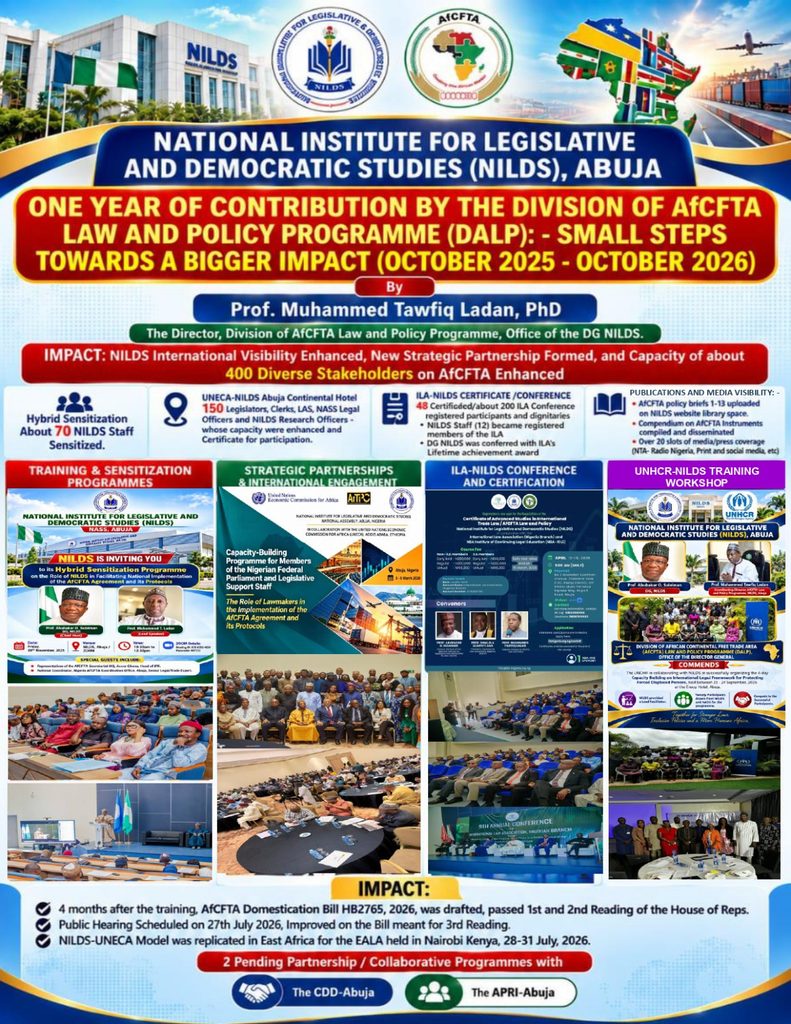
Titled “Small Steps Towards a Bigger Impact,” the scorecard documents a year of staff sensitisation, parliamentary training, international legal engagement, research publications and contributions to Nigeria’s AfCFTA legislative process. ONE YEAR OF CONTRIBUTION BY THE…

For an institution completing its first year, the record offers a substantial foundation: a programme connecting legal scholarship with the practical demands of implementing the African Continental Free Trade Area.

Building knowledge within NILDS

The Division’s recorded activities began with a hybrid sensitisation programme for NILDS staff on 28 November 2025, reaching approximately 70 staff members.

Starting within the Institute gave the programme an important institutional base. Effective support for lawmakers depends on the knowledge of the researchers, legal officers and other personnel who prepare analysis, interpret policy and support legislative work.

The sensitisation programme therefore formed an early step towards strengthening NILDS’ own ability to engage with the AfCFTA Agreement and its protocols.

Equipping the people who shape legislation

A major milestone followed on 3–5 March 2026, when NILDS and the United Nations Economic Commission for Africa (UNECA) organised a capacity-building programme at the Abuja Continental Hotel.

The Division’s scorecard records 150 participants, including legislators, clerks, legislative aides, National Assembly legal officers and NILDS research officers, whose capacity was enhanced and who received participation certificates.

An independent account by the United Nations Economic Commission for Africa confirms that the three-day workshop brought together 150 participants and was organised through its African Trade Policy Centre, in collaboration with NILDS and with contributions from the AfCFTA Secretariat.

The programme addressed the legislature’s responsibilities in implementing the Agreement, including domestication, oversight, intellectual property and digital trade. Participants adopted a resolution calling for stronger institutional support, executive–legislature cooperation and wider stakeholder engagement. United Nations Economic Commission for Africa

Its significance lies in the responsibilities of those trained. Legislators determine the laws; clerks and legislative drafters support their preparation; research and legal officers help establish the evidence and legal reasoning on which informed decisions depend.

Supporting Nigeria’s AfCFTA legislative process

The scorecard identifies progress on the AfCFTA Domestication Bill, HB 2765, 2026, among the developments associated with the Division’s first-year work.

It reports that, four months after the March training, the Bill had been drafted and passed its first and second readings in the House of Representatives. It also records a public hearing scheduled for 27 July 2026 and improvements to the Bill intended for third reading.

LegalLinkz’s earlier coverage of the public hearing documented Professor Ladan’s presentation of a memorandum prepared with NILDS colleagues Dr. Usman Ibrahim and Dr. Shamsu Yahya.

Their submission addressed legislative oversight, institutional coordination, stakeholder inclusion and implementation reporting. It recommended measurable performance indicators and stronger accountability arrangements. legallinkz.com

This contribution gives practical expression to the Division’s mandate. Training builds understanding; a carefully prepared memorandum brings that understanding into the scrutiny of proposed legislation.

For Professor Ladan and his team, the achievement is a documented contribution to the national conversation about how AfCFTA commitments should operate within Nigeria’s legal and institutional framework.

Connecting Nigeria’s experience with East Africa

The Division also reports that the NILDS–UNECA training model was replicated for the East African Legislative Assembly (EALA) at a programme in Nairobi, Kenya, from 28–31 July 2026.

UNECA’s account of the Nairobi workshop independently confirms the dates and the participation of EALA’s Standing Committee on Communication, Trade and Investment.

The workshop focused on strengthening legislators’ understanding of the Agreement, its protocols and the relationship between continental integration and existing regional frameworks. United Nations Economic Commission for Africa

The Division’s reported connection between the Abuja and Nairobi programmes adds a continental dimension to its anniversary record. It points to the value of sharing approaches to parliamentary capacity building across institutions confronting similar implementation questions.

Expanding professional engagement through the ILA

Another significant achievement was the ILA–NILDS certificate programme and conference held from 13–16 April 2026.

According to the scorecard, 48 participants received certificates, while approximately 200 registered participants and dignitaries attended the International Law Association conference.

The programme also produced lasting professional connections: 12 NILDS staff became registered members of the ILA, while the Director-General of NILDS received the association’s Lifetime Achievement Award.

These figures represent different forms of participation and should be read separately from the Division’s overall estimate of about 400 stakeholders whose capacity was enhanced.

The professional memberships are particularly relevant to the Institute’s longer-term work. They create opportunities for continued engagement with international legal scholarship and professional networks beyond the duration of a single conference.

NILDS : Creating resources that outlast the classroom

The Division’s work extended into publications and public communication.

Its scorecard records AfCFTA Policy Briefs 1–13 uploaded to the NILDS website library, alongside a compiled and disseminated compendium of AfCFTA instruments.

The NILDS institutional repository also lists AfCFTA research attributed to Professor Ladan, including work on national implementation and the Guided Trade Initiative. ir.nilds.gov.ng

Such resources preserve knowledge beyond training events. They provide reference material for researchers, legislative personnel and other readers seeking to understand the Agreement and its implementation.

The scorecard further records more than 20 media and press coverage slots, including appearances or coverage on NTA, Radio Nigeria, print and social media platforms.

Together, the publications and media engagement broadened the channels through which the Division’s work could reach both specialist and public audiences.

Recognising Professor Ladan’s leadership

Professor Muhammed Tawfiq Ladan’s contribution deserves recognition for the coherent direction evident in the first-year programme.

The official NILDS faculty listing identifies him as Director of the Division of AfCFTA Law and Policy in the Office of the Director-General. His documented research and legislative engagement show a professional focus on connecting legal analysis with implementation. NILDS CAEEP

Under his direction, the anniversary record brings together activities that reinforce one another: sensitisation supports institutional understanding, training strengthens legislative capacity, publications preserve knowledge, and policy submissions bring research into public decision-making.

Credit also belongs to the NILDS leadership, the Division’s personnel, participating institutions and development partners whose contributions made these activities possible.

The first-year achievements offer a fitting occasion to acknowledge Professor Ladan’s stewardship while celebrating the collective effort behind the programme.

NILDS : A foundation for the next year

The scorecard identifies two pending partnership or collaborative programmes with CDD–Abuja and APRI–Abuja, indicating further work under development.

The accompanying anniversary graphic also highlights a UNHCR–NILDS training workshop, illustrating a broader programme of institutional engagement. 

For DALP, the next chapter will build on an established base of trained stakeholders, research materials, professional relationships and legislative contributions.

Its first anniversary provides a clear reason for celebration: within one year, the Division has assembled a body of work directed at one of Africa’s most demanding policy tasks—giving continental trade commitments practical legal and institutional meaning.

The full one-year scorecard is attached for readers seeking the detailed record of the Division’s activities and reported achievements.


NILDS AfCFTA Division Lists One-Year Achievements, Says Capacity of 400 Stakeholders Enhanced

The Division of AfCFTA Law and Policy Programme (DALP), Office of the Director-General, National Institute for Legislative and Democratic Studies (NILDS), has recorded significant milestones in its first year of operation from October 2025 to October 2026.

In a one-year scorecard titled “Small Steps Towards A Bigger Impact”, the Director of the Division, Professor Muhammed Tawfiq Ladan, said the activities of the Division enhanced NILDS’ international visibility, formed new strategic partnerships and built the capacity of about 400 diverse stakeholders on AfCFTA.

According to the report, the Division commenced with a hybrid sensitization programme for NILDS staff on November 28, 2025, where about 70 staff were sensitized on the AfCFTA.

This was followed by a continental training programme co-organized by UNECA and NILDS at the Continental Hotel, Abuja, from March 3-5, 2026. The training enhanced and certificated the capacity of over 150 legislators, clerks, Legislative Aides, National Assembly legal officers and NILDS research officers.


The Division also facilitated the LA-NILDS Certificate/Conference from April 13-16, 2026, where 48 participants were certificated and about 200 participants and dignitaries attended the International Law Association (ILA) Conference. The report noted that 12 NILDS staff became registered members of the ILA, while the Director-General of NILDS was conferred with the ILA Lifetime Achievement Award.

On publications and advocacy, the Division stated that AfCFTA Policy Briefs 1-15 have been uploaded on the NILDS website library space, while a Compendium on AfCFTA instruments has been compiled and disseminated. It added that the Division secured over 20 media and press coverage slots on NTA, Radio Nigeria and other platforms.

On impact, Prof. Ladan disclosed that four months after the UNECA-NILDS training, the AfCFTA Domestication Bill, HB 2765, 2026, was drafted, passed first and second reading at the House of Representatives, with public hearing scheduled for July 27, 2026, and improvements made for third reading.

He also stated that the NILDS-UNECA training model was replicated in East Africa by the East African Legislative Assembly (EALA) at a programme held in Nairobi, Kenya, from July 28-31, 2026.

The report further listed two pending partnership and collaborative programmes with the Centre for Democracy and Development (CDD), Abuja and the African Development.


Wednesday, September 23, 2026

Nigeria Must Merge Defence, Tech and Democracy to Secure Nation, Avoid Leaving Behind Empty Shell of Sovereignty – Prof MT Ladan Warns


The Coordinating Director of the Africa Continental Free Trade Agreement (AfCFTA) Law and Policy Programme Division, Office of the Director General, National Institute for Legislative and Democratic Studies, NASS Abuja, Prof. Muhammed Tawfiq Ladan, has warned that Nigeria risks “an empty shell of sovereignty” if it secures its borders while compromising democratic values.

Prof. Ladan gave the warning on Thursday, 3rd September 2026 while delivering the keynote address at the 2026 Policy Dialogue organized by Saban Media Services Abuja.

The event, themed “Securing the Sovereign Frontier: Strategic Defence Architecture, Emerging Technologies, and Democratic Integrity in Nigeria,” held at the Armed Forces Events and Multipurpose Centre, Asokoro, Abuja. The Minister of Defence, Retired General Christopher Musa, declared the colloquium open.

Setting the tone, Prof. Ladan anchored Nigeria’s security mandate on the Constitution. “Under Section 14(2)(b) of the Constitution of the Federal Republic of Nigeria 1999 (as amended), it is explicitly declared that ‘the security and welfare of the people shall be the primary purpose of government.’

“This constitutional clause serves as the foundational, non-negotiable social contract between the Nigerian state and its citizens,” he said, adding that: “Fulfilling this mandate requires framing security not merely as a kinetic military endeavor, but as the bedrock of constitutional survival, institutional stability, and public trust.”

Prof. Ladan told participants that the battlefield has changed. “As Nigeria navigates the complex geopolitical and technological terrain of late 2026, the definition of the ‘sovereign frontier’ has fundamentally shifted.

He said, “Sovereignty is no longer exclusively contested on physical landmasses, maritime zones, or isolated battlefields like the Lake Chad Basin and the Sambisa Forest. It is actively fought, compromised, and defended within digital ecosystems, telecommunications routing, cloud servers, and global information pipelines,” stressing that “Borders extend beyond physical landmass and maritime zones into cyberspace, critical national infrastructure, and information ecosystems.”

The keynote speaker called for a new security framework. “Nigeria’s strategic defence architecture must evolve beyond isolated, single-service responses toward a synchronized, inter-agency framework. It must merge physical readiness with sophisticated, technology-driven defensive capabilities. Crucially, this transition must be governed by institutional transparency to ensure that protecting the state does not inadvertently weaken the democratic integrity, rule of law, and civil liberties of the people.”

On technology, he said: “Securing the nation depends heavily on leveraging indigenous innovation, artificial intelligence, unmanned aerial surveillance, and secure communication hardware. Bridging the gap between defense research and practical field deployment under active statutory frameworks is essential for long-term operational success.”

Prof. Ladan identified three key policy instruments for national renewal. He stated: “The Defence Industries Corporation of Nigeria (DICON) Act 2023 provides a robust legal mechanism to stimulate a domestic defense-industrial complex. By prioritizing public-private partnerships, Nigeria can incentivize indigenous innovations in unmanned aerial vehicles (UAVs), biometric tracking systems, and encrypted tactical communications hardware, systematically reducing vulnerable dependencies on foreign supply chains.” On cybersecurity, he said: “Backed by the National Cybersecurity Policy and Strategy (NCPS) and the enforcement mechanisms of the Cybercrimes (Prohibition, Prevention, etc.)

Amendment Act 2024, Nigeria possesses the statutory foundation to build an integrated cyber-command. This enables proactive threat hunting, the protection of critical national infrastructure, and the defense of the information ecosystem against coordinated disinformation and state-sponsored cyber espionage.”

On trade, he noted: “The African Continental Free Trade Area (AfCFTA) Protocol on Digital Trade presents an immense economic and strategic prospect. By establishing harmonized standards for cross-border data flows, cybersecurity, and digital identities across Africa, Nigeria can position its tech sector as a regional hub for secure software, dual-use technologies, and secure cloud infrastructure. This strengthens economic resilience while projecting digital sovereignty across the West African sub-region.”

Prof. Ladan also made specific recommendations to stakeholders. To the Executive and National Security Leadership, he said: “Immediately bridge the execution gap between the National Cybersecurity Policy, the DICON Act 2023, and the AfCFTA Digital Trade commitments to create a unified National Security-Tech Roadmap.”

Prof Ladan also called for the establishment of “a Civil-Military Technology Oversight Board” to “audit the procurement and deployment of surveillance tech, ensuring strict compliance with data privacy rights.”

To the Armed Forces and Intelligence Agencies, he urged them to “Break down institutional silos between the military, Nigeria Police Force, and intelligence agencies by establishing a centralized, AI-driven Joint Threat Intelligence Fusion Centre” and to “Shift personnel recruitment and continuous training heavily toward cybersecurity, electronic warfare, and algorithmic data analysis.”

To the National Assembly, he recommended: “Enact proactive legislation defining the ethical bounds of Artificial Intelligence (AI), automated weapons systems, and facial recognition technologies in domestic law enforcement” and “Ensure that capital allocations under the DICON framework are tied strictly to measurable local capacity building, research output, and technological self-reliance.”

To the Private Sector and Civil Society, he said: “Seize the commercial opportunities within the DICON Act and AfCFTA frameworks to pitch secure, locally built enterprise data tools capable of dual-use deployment” and “act as an independent watchdog against digital authoritarianism, while actively collaborating with state institutions to debunk malicious deepfakes and coordinated disinformation campaigns.”

In his conclusion, Prof. Ladan said: “Securing Nigeria’s sovereign frontier in 2026 requires an understanding that national security and democratic integrity are mutually reinforcing realities, not a zero-sum trade-off. A state that compromises its democratic values to secure its physical geography leaves behind an empty shell of sovereignty.” He added: “By leveraging the statutory weight of the DICON Act, enforcing modern cybersecurity laws, and championing the regional integration promised by the AfCFTA Protocol on Digital Trade, Nigeria can build a formidable, tech-driven defense architecture. Ultimately, grounding this strategic pivot in the sacred constitutional mandate of Section 14(2)(b) ensures that as Nigeria guards its borders, it preserves the vital democratic freedoms that make the nation worth defending.”

Nigeria’s Prof. MT Ladan Decries Compliance Gap in ECCJ, As Only 38 Judgments Enforced In 20 Years


The ECOWAS Community Court of Justice is battling a serious compliance deficit, with only 38 of its judgments fully enforced in its 20 years of judicial activity from 2005 to December 2025, and one judgment partially enforced.

The enforcement figures were contained in a paper by a renowned law scholar, Prof. M.uhammed Tawfiq Ladan, titled “The Quest for an Appellate Chamber for the ECOWAS Court of Justice: Building Member States Consensus and ECOWAS Institutions’ Support,” presented in Dakar, Senegal.

According to the data contained in his paper, enforcement is divided almost equally between cases against Member States and cases against ECOWAS Institutions themselves.

Out of the total figure, Member States account for only 19 fully enforced judgments and one partially enforced judgment, despite being the major respondents before the Court.

A breakdown strictly from the paper shows Nigeria leading with 10 fully enforced judgments. The Gambia follows with 4, Senegal with 3, while Liberia, Sierra Leone and Togo have one each, with the Togo case recorded as partially enforced.

The paper reveals that six Member States have no record of enforcement at all within the period under review, namely Benin, Cabo Verde, Cote D’Ivoire, Ghana, Guinea Bissau and Guinea.

On the other hand, ECOWAS Institutions account for 18 enforced judgments, with the ECOWAS Commission accounting for the bulk with 14 cases.

The remaining institutional compliance comes from the ECOWAS Parliament, the ECOWAS Bank for Investment and Development, the West African Monetary Agency and the West African Power Pool, with one enforced judgment each.

Prof. Ladan in his paper linked the low compliance rate directly to the failure of many Member States to designate Competent National Authorities to receive and enforce writs of execution from the Court, as required by the Court’s Protocol.

He disclosed in the paper that as of August 2024, only 10 out of 15 Member States have complied with appointing a National Authority, a process that began 13 years ago with Nigeria’s appointment.

The 10 countries and their dates of appointment as listed in the paper are Nigeria – June 9, 2011; Togo – June 6, 2018; Ghana – June 11, 2020; Guinea – October 13, 2020; Cote D’Ivoire – March 12, 2022; The Gambia – February 7, 2023; Senegal – June 6, 2023; Guinea Bissau – July 24, 2023; Sierra Leone – November 13, 2023; and Liberia – August 5, 2024.

This leaves five Member States that are yet to appoint any authority as of August 2024, which are Benin, Burkina Faso, Cabo Verde, Mali and Niger.

Ladan recalled in the paper that the issue of compliance was also at the front burner at the 2025 ECOWAS Court Meeting on Compliance, where stakeholders stressed the need to strengthen the capacity of National Authorities.

He warned in the paper that establishing an Appellate Chamber alone will not solve the compliance problem, noting that of the four major issues to be considered – resource intensiveness, amendment of protocols, scope of appeal, and compliance mechanisms – the last is the most critical.

To address it, he recommended in the paper that the ECCJ should emulate the Court of Justice of the European Union, CJEU, which achieves high compliance by influencing national legal systems to enforce its rulings through regular bilateral meetings.

He further proposed in the paper the adoption of an ECJ-like preliminary ruling procedure, where national courts refer questions of ECOWAS law to the ECCJ for interpretation, arguing that this will foster cooperation rather than competition.

NILDS AfCFTA Policy Programme records key milestones

  The Division of AfCFTA Law and Policy Programme (DALP), Office of the Director-General, National Institute for Legislative and Democratic ...